
Computerized doctor's diary — every patient written in the diary on arrival for treatment
BaseCRM keeps a doctor's diary under Schedule 6: one click from the appointment, a running number for the tax year with no editing and no deletion, the appointment history as part of the books, and a printout with a page per day. For psychologists, physiotherapists, doctors, dentists and veterinarians.
Who must keep a doctor's diary
Schedule 6 of the Income Tax (Bookkeeping) Regulations sets out how a doctor keeps their books, and defines "doctor" broadly:
- Doctors
- Psychologists
- Physiotherapists
- Dentists and dental therapists
- Veterinarians
Under section 2, a doctor's bookkeeping system includes at least a diary, receipts, invoices and a file of external documents. The diary is the part receipts and invoices do not replace: it records who was received for treatment and when, even on a day when nothing has been paid yet.
What the regulations require — and what BaseCRM does
Each row points to the section it comes from
| What the regulations require | What BaseCRM does |
|---|---|
| A separate page for each day, with the date Section 3(a) | A daily screen for every date, and the printout starts a new page for every day that has a line. |
| Every patient's name, and whether it was a home or night visit Section 3(a)(2) | The patient's name is taken from the customer card or typed in, and a home or night visit is marked on the line itself. |
| The patient's name is written on arrival for treatment Section 3(b)(1) | A click on "Arrived for treatment" next to the appointment, and the time the line was written is kept. A line for a day that has not yet come is refused. |
| The amount received, and the name of the party liable when the payer is not the patient Section 3(a)(3)–(4) | An "Other payer" field on every line, and the amounts come from the receipts issued that day. |
| The receipt number Section 3(a)(5) | Every receipt and tax invoice-receipt of the day is shown in the diary by its number, with the payment method. |
| Notes Section 3(a)(7) | A notes field on every line. |
| A separate summary for each day Section 3(b)(2) | The number of patients received and the day's total receipts are calculated for every day, on screen and in the printout. |
| The advance registration of patients is kept as part of the books Section 4 | Every booking, change, cancellation and deletion of an appointment is kept in the diary's history, including appointments that came from Google Calendar sync. |
| A computerized diary is a "permanent file": no deletion, and sequential numbering through the tax year Section 1 | Every line has a running number for the tax year. No editing and no deletion: a mistake is corrected with a void line stating the reason, and the original line stays, marked as void. |
| A printout: the taxpayer's name, the period, the production date, page numbering and an end mark Appendix E | A PDF for a day or a period, with all of these at the foot of every page and "end of output" on the last page. |
| Keeping the bookkeeping system for seven years from the end of the tax year Section 25(c) | Deleting a patient who has lines in the diary is blocked until the retention period ends, and the message states the date. |
This is what the doctor's diary looks like in BaseCRM
Screenshots from the clinic demo business


Paper doctor's diary vs. computerized doctor's diary
The same obligation, two ways to meet it
| A bound book, by hand | Computerized diary in BaseCRM | |
|---|---|---|
| Recording the patient | By hand, on arrival for treatment | A click on "Arrived for treatment", and the time is kept |
| Numbering | Pages numbered in advance | An automatic running number for the tax year |
| A mistake | A written correction, in the book itself | A void line with a reason, and the original stays |
| Receipts and receipt numbers | Copied from each receipt | Taken from the receipts issued, by their number |
| Daily summary | Worked out by hand, every day | Calculated automatically |
| Appointments booked in advance | A separate appointment book that has to be kept | Kept with every change, as part of the diary |
| Seven years of retention | Physical books in a safe place | In the system, and deleting a patient is blocked during the retention period |
How it works
The diary is written from your everyday work with appointments
The diary is already on
In a clinic-type business the diary is switched on automatically. In any other business you switch it on in Settings.
A patient arrives
Click "Arrived for treatment" next to the appointment, on the daily screen or on the appointment page. A patient without an appointment is recorded by name.
A mistake? A void line
Write the reason, and the void is recorded as a new line that points to the original.
Print it
One day or a period, to a PDF with a page per day — for your accountant or an audit.
What the diary does not do yet
So that you don't find out later:
- The payments (expenses) column of section 3(a)(6) is not shown in the diary. Expenses are managed on the expenses screen.
- There is no patient card and no precious-metals inventory list, which section 2(b) requires of dentists and dental therapists.
- An accountant with access to the business does not see the diary screens. To pass the diary to them, produce a PDF.
About the software's registration with the Tax Authority
The Israel Tax Authority registers software and does not approve it, and the registration certificate itself states that registration does not confirm the software is fit for bookkeeping. BaseCRM is registered with the Israel Tax Authority as software for managing a computerized bookkeeping system (registration no. 259701), and receipts and invoices are issued in it — you can verify the software's registration with the Israeli Tax Authority. The diary is kept by BaseCRM according to the requirements of Schedule 6, as set out in the table above, section by section.
Frequently asked questions about a computerized doctor's diary
Go deeper
Digital appointment management
Guide to switching to digital appointment management and booking
To the guideDigital invoices in Israel
Legal requirements and tools for issuing invoices for therapists
To the guideA therapy session recorded and transcribed — and the transcript stays on the appointment
Record a full session, up to 90 minutes, and get a transcript attached to the appointment. The recording is transcribed on BaseCRM’s transcription server and is not sent to external AI services.
- Completing the notes after a long session
- An intake conversation with a new client
- Going back to what was agreed in the previous session
-
Consent before anything else
Before recording, the participants confirm the meeting is being recorded. Without that confirmation, recording does not start.
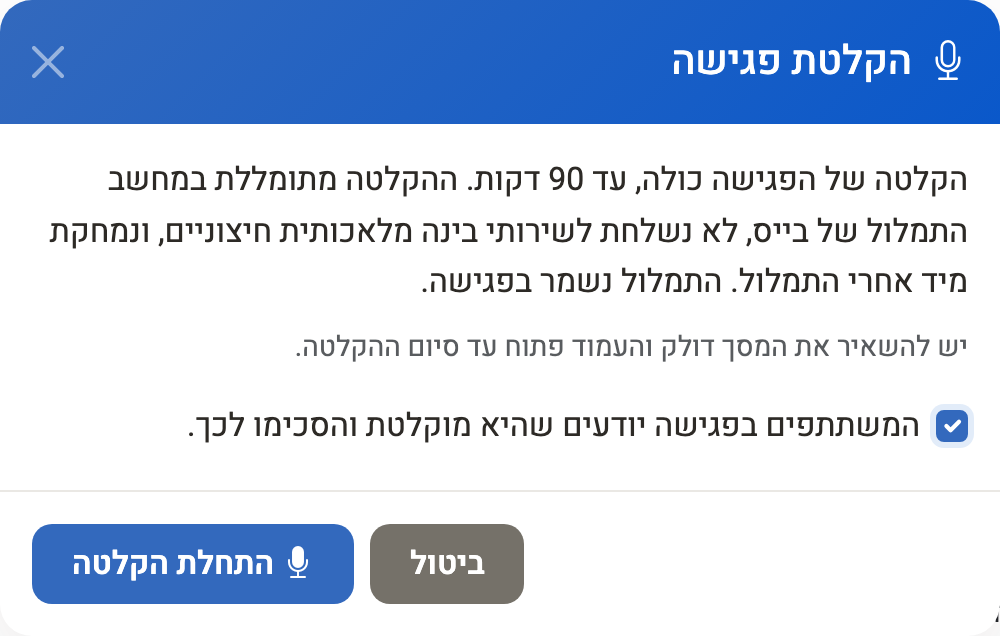
-
Record up to 90 minutes
On the appointment, choose “Record the meeting + transcript”, from the phone or the computer. The recording uploads in parts during the meeting.
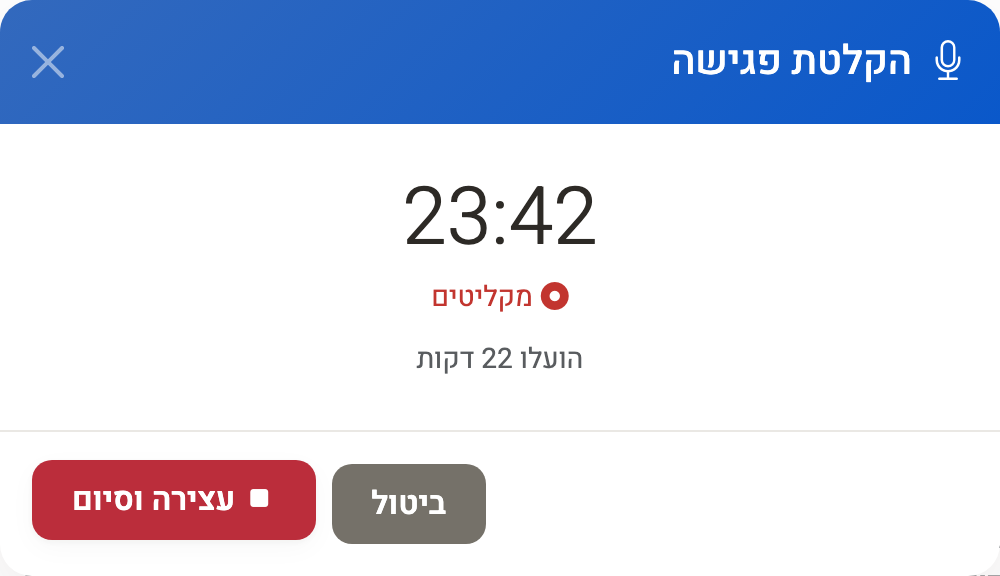
-
The transcript arrives on the appointment
Usually within a few minutes of the end, with a notification. Copy it or add it to the appointment description with one click.
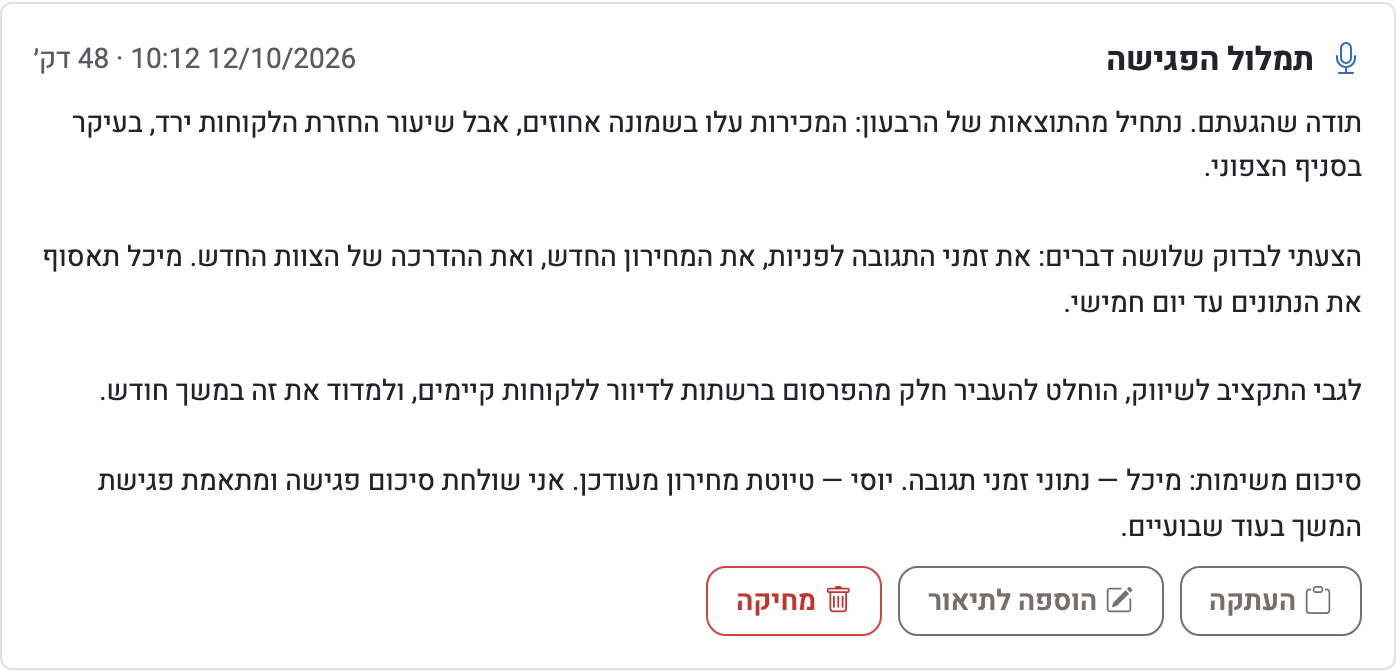


- The recording is transcribed on BaseCRM’s transcription server. It is not sent to external AI services.
- The audio is deleted right after transcription. The transcript is stored encrypted, and everyone authorised to see the appointment can read it.
- The transcription engine was trained on spoken Hebrew.
The transcript usually appears within a few minutes after the recording ends, and a notification is sent when it is ready. If the transcription server is offline at that time, the recording waits for it; a recording not transcribed within 7 days is deleted.
A doctor's diary written from your appointments
First year free — For businesses joining by 31.10.2026. When the free period ends: ₪29 a month, locked for the life of the subscription (instead of ₪99), for the whole business. Sign up without a credit card.
Sign up