
Accounting firm management software — the firm's clients, documents and collections in one place
A filing board with every client's deadlines, material requested from the client by link, a file for every client, invoices in English and dollars and email in the client's language. A system for running the firm itself — not bookkeeping software for its clients.
The problems that come up in running an accounting firm
The firm as a business — what bookkeeping software does not do
An invoice in English or in dollars
A document prepared separately by hand, and an exchange rate nobody recorded
No way to know if the document arrived
A payment request went out — and there is no way to tell whether it was delivered or bounced
Reminders by hand
A client who has not paid is reminded only when someone at the firm remembers to write
Anti-money-laundering record
Identification, the beneficiary declaration and the risk assessment scattered across folders and emails
How BaseCRM solves it
The accountants module is built on everything every business in the system gets — clients, invoices, calendar and documents
Filing board: what every client has to file, and by when
For each client you set once what they file and how often, and the board builds itself — month after month, with every report's deadline and where that deadline comes from.
- Periodic and detailed VAT reports, income-tax advances, withholding (form 102), the exempt dealer's declaration and the annual return
- Deadlines by the Tax Authority's yearly announcement, and by law where there is none — with the annual return by the quota arrangement; the source is written beside every date
- A status for every report — awaiting material, material received, in progress, filed, paid — with late reports from earlier months at the top of the board
- A daily reminder to the person responsible about reports due in the coming week or already late, and one profile set up for many clients at once

Material from the client, by link
Instead of chasing invoices on WhatsApp: the firm chooses what to ask for, and the client gets a link to upload the files — without logging in, in their own language.
- Ready-made items — sales and expense invoices, bank statements, credit cards, payslips — or an item in the firm's own words
- The files are saved to the client's attachments at the firm; the client sees only the names of the files they sent
- When the client marks that everything has been sent, the report on the board moves to "material received" and the person responsible is notified
- One request to many clients from the board at once — with a ready WhatsApp message or by email

Documents in English and in foreign currency
The binding document stays in Hebrew, as required. Next to it, an English copy with the same number, marked as a copy — and a client whose language is English receives it attached to the email.
- Invoices in dollars or euros — amounts are also recorded in shekels, at the Bank of Israel representative rate for the document date
- The rate and its date are stored on the document; a different rate is entered manually and requires a reason
- A receipt against a foreign-currency document is recorded at the rate the document applied, so the balance closes exactly
- The firm's name and address in English are entered once in the settings

Email in the client's language, and tracking whether it arrived
Each client has a language, and the email goes out in it, worded for the type of document — invoice, receipt or credit note. Every document shows when it was sent, to which address and what happened to it.
- Send history for every document: sent, delivered, rejected or bounced
- "Opened" is shown as an indication only — some mail servers load a message without anyone opening it
- Sending a document by email requires recording the client's consent to receive a computerized document
- Automatic payment reminders to clients who have not paid, at the stages the firm chooses

A file for every client, in the firm's work stages
Every client gets a file that moves through an accounting firm's stages, with its documents, tasks, meetings and signed agreements.
- Ready-made stages: client onboarding, active file, waiting for the client's material, in preparation, awaiting the client's approval, filed and file closed
- A sample engagement letter for digital signing on mobile — a draft the firm edits, with no fee contingent on the result
- Recording a payment against a transaction invoice issues the tax document — a tax invoice-receipt, or a receipt for an exempt dealer
- A "standing order" payment method on receipts — the system records the payment received and does not collect it itself

Anti-money-laundering record
Section 8B of the Prohibition on Money Laundering Law applies to an accountant providing one of five business services. Every file keeps the firm's determination and what the order requires to be recorded.
- Whether the file is a business service — the system does not decide, and "not yet determined" is never counted as "no"
- Client identification, the beneficiary declaration and the risk assessment — with a list of what is still missing
- The date the service was provided, from which the five years of retention are counted
- A client whose records are still within the retention period cannot be deleted

Connection to monday.com
A firm that keeps its client list on a monday board imports it once, and from then on the system updates the board itself.
- Import clients from an existing board, through the client import mapping screen
- Changes to a client are pushed to the columns you chose on the board
- Only the fields you mapped leave the system
- The connection is one-way — the system is the source of truth, and an update on the board does not come back to it

What the system does not do
So that it is clear before you sign up
- Double-entry bookkeeping for the firm's clients
- Payroll and payslips
- Filing reports with the Tax Authority on behalf of clients
- Pulling data from a bank account or a credit card
- Collecting payments by standing order
Frequently asked questions
A client meeting recorded and transcribed — what was agreed, without taking notes as you go
Record a full meeting, up to 90 minutes, and get a transcript attached to the appointment — what the client said, which documents are missing and what was decided.
- An onboarding meeting with a new client
- An annual report and tax planning meeting
- A conversation about missing documents and who sends what
-
Consent before anything else
Before recording, the participants confirm the meeting is being recorded. Without that confirmation, recording does not start.
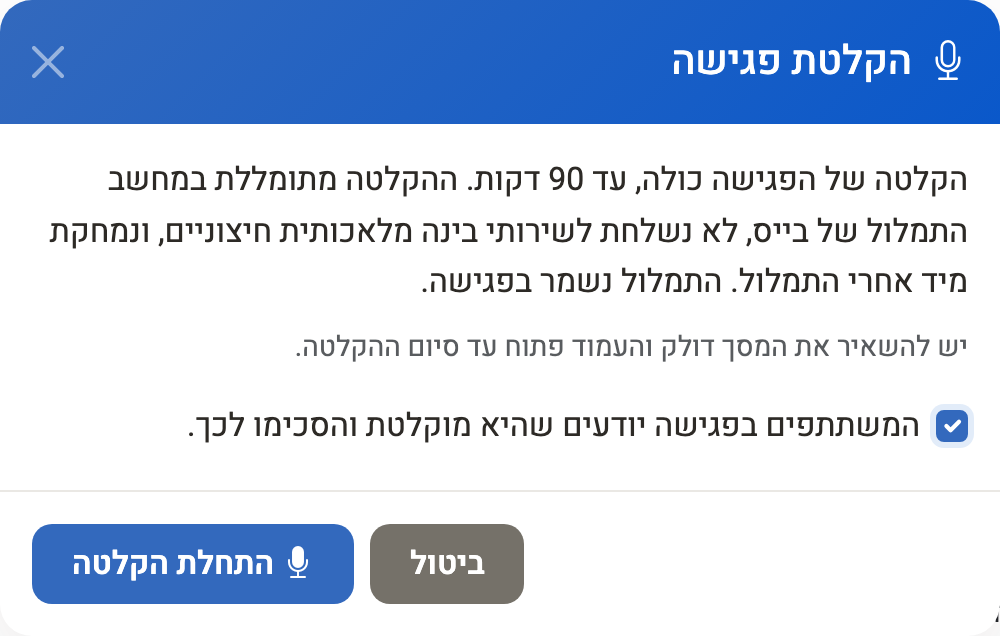
-
Record up to 90 minutes
On the appointment, choose “Record the meeting + transcript”, from the phone or the computer. The recording uploads in parts during the meeting.
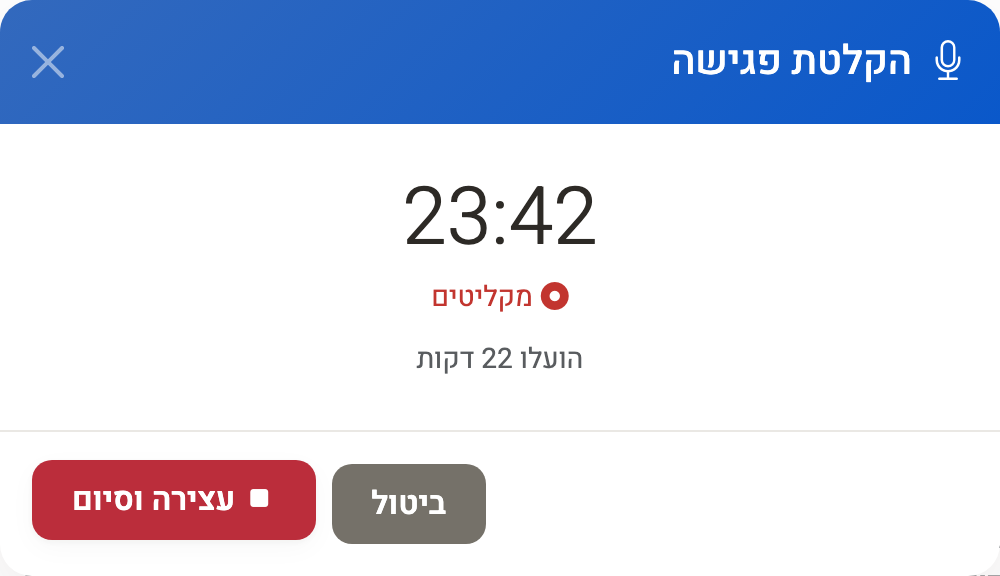
-
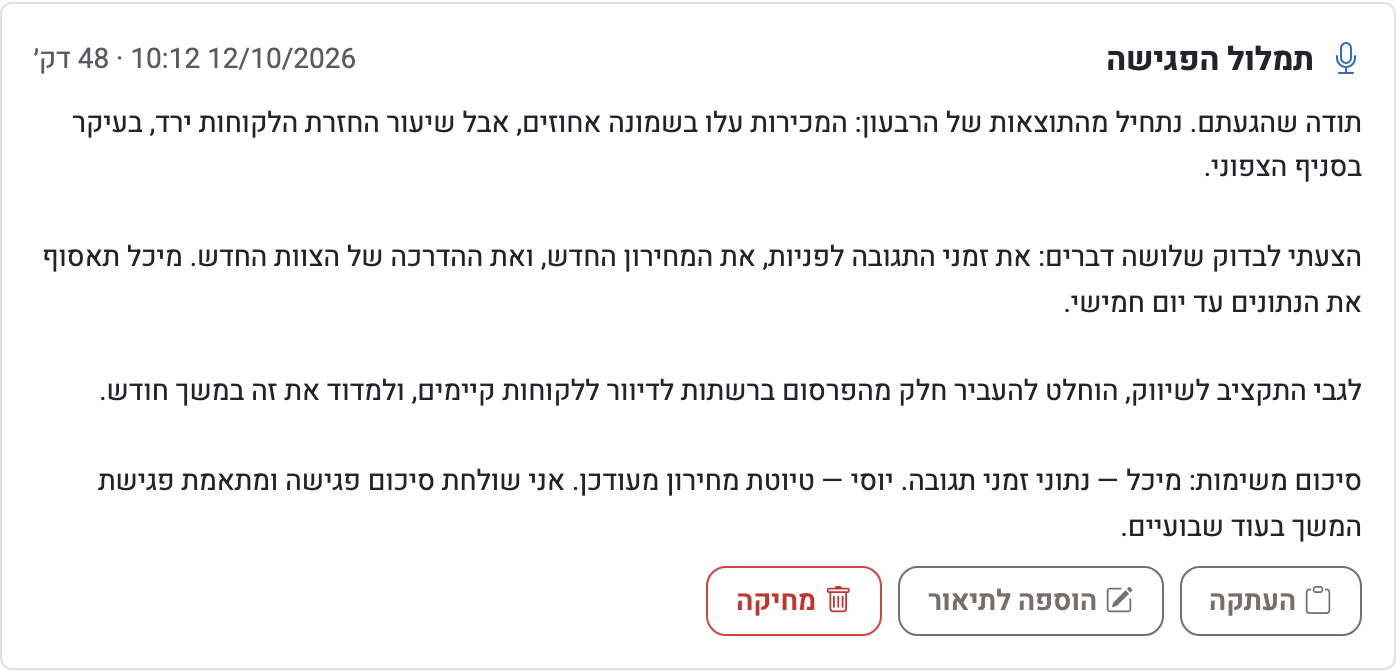
The transcript arrives on the appointment
Usually within a few minutes of the end, with a notification. Copy it or add it to the appointment description with one click.


- The recording is transcribed on BaseCRM’s transcription server. It is not sent to external AI services.
- The audio is deleted right after transcription. The transcript is stored encrypted, and everyone authorised to see the appointment can read it.
- The transcription engine was trained on spoken Hebrew.
The transcript usually appears within a few minutes after the recording ends, and a notification is sent when it is ready. If the transcription server is offline at that time, the recording waits for it; a recording not transcribed within 7 days is deleted.