
Invoice allocation system — the request goes to the Tax Authority the moment you issue
BaseCRM is connected directly to the Tax Authority's allocation service. After a one-time connection of the business, every tax invoice above the threshold receives its allocation number at the moment of issuance — the number is printed on the document and included in its digital signature.
Why an allocation system rather than typing it in on the Tax Authority website
You can obtain an allocation number with no software at all: sign in to the personal area on the Tax Authority website, enter the invoice details, get a number and type it back. That is entirely legal, and it is what many businesses do today. The question is not whether it is possible but what it costs you — for each invoice separately, every single time, when every keystroke is one more chance to get a document that is reported to the Tax Authority wrong.
Registered software connected to the allocation service does the same thing without you doing anything: it knows by itself which invoices require a number, sends the request at the moment of issuance, and writes the number onto the document. The difference between the two routes is not the validity of the number — that is identical — but your time, and how many openings human error is given.
When Base requests an allocation number — the exact rule
Today: every tax invoice above 5,000 ₪ before VAT, in force since 1.6.2026
The five conditions
- The document is a tax invoice or a tax invoice-receipt
- The amount before VAT is above 5,000 ₪ — strictly above, not equal to it
- The transaction is subject to VAT (a zero-rated transaction needs no number)
- The customer has a business tax ID — the request is keyed on it
- The invoice has not been fully credited by a credit note
The threshold over the years
| In force from | Threshold (before VAT) |
|---|---|
| 1.6.2026 | ₪5,000 |
| 1.1.2026 | ₪10,000 |
| 1.1.2025 | ₪20,000 |
| 5.5.2024 | ₪25,000 |
The amount is measured before VAT, and that is the most common mistake on the subject: a business looking at the final figure on the invoice believes it is under the threshold when it is above it, and finds out when the customer cannot deduct the VAT. BaseCRM calculates this from the document date, so an invoice issued today for an earlier period is measured against the threshold in force then.
Manual vs. automatic
The very same number, two very different ways to get it
| Manually, via the personal area | Automatically, in BaseCRM | |
|---|---|---|
| Who requests the number | You, on the Tax Authority website, for each invoice separately | The system, in the background, at the moment of issuance |
| How long it takes | Minutes per invoice — sign in, identify, enter, copy back | A second, without leaving the screen |
| Re-typing | Yes — and therefore typing errors too | None. The number is written onto the document directly |
| Invoices that piled up | One by one | One batched request for everything waiting, in a single click |
| An invoice held for review | You handle it with the Authority separately | The alternatives appear on screen, and your choice is reported back |
| Digital signature | The document is signed before the number arrives | The document is re-signed so the number is part of the signature |
Connect once, and then it happens by itself
Four steps, three of which happen without you
Connect the business
Once: click Connect on the allocation numbers screen (or on the connect button shown on an invoice waiting for a number), identify yourself on the Tax Authority website and approve. It takes minutes.
Issue an invoice
Exactly as always. The system checks by itself whether this invoice requires an allocation number.
The number comes back
The request is sent to the Tax Authority and the number comes back, without you doing a thing.
Printed and signed
The allocation number appears on the PDF, and the document is re-signed so the number is part of the digital signature.
The Tax Authority authorisation is valid for three months. BaseCRM sends a renewal reminder two weeks before it expires — so you do not find out from a pile of invoices with no number.
What happens when things do not go smoothly
Most systems describe the case where everything worked. These are the other three
Invoices that piled up
Invoices waiting for a number — because the connection did not yet exist, or because the Authority did not answer — receive numbers in one batched request, not one by one.

A delayed invoice
The Tax Authority may hold an invoice for review. That is not a refusal. The system presents the alternatives the Authority allows and reports your choice back.

A supplier number that is not genuine
Input VAT may be deducted only against a genuine allocation number. On the expenses screen you click "Check" next to the supplier's allocation number and the number is verified with the Tax Authority: invoice details the Authority holds fill empty fields, and any contradiction with what was typed is flagged.

What exactly is connected, and what is not
BaseCRM is registered with the Tax Authority as software for managing a computerised accounting system, registration number 259701 — you can verify the software's registration with the Israeli Tax Authority. Every allocation request goes out in your business's name, on the basis of the authorisation you yourself gave the Tax Authority.
BaseCRM also transmits the uniform-structure (Open Format) file to the Tax Authority: when a demand letter arrives from the assessing officer, you mark it at export and the file is sent straight from the system after identifying with the Tax Authority (the general obligation starts in January 2027). And one thing the system does not do yet, so you don't find out later: it does not file the VAT report through the interface, because the Tax Authority opened that filing to representatives only. PCN874 export is in the system and is used to file the usual way.
Invoice allocation system — frequently asked questions
Go deeper
The complete allocation-number guide
What the law says, who is liable, what happens if you are not compliant, and a checklist for choosing software
To the guideAllocation number checker
Free tool: enter an amount and find out whether the invoice needs a number
To the toolA client meeting recorded and transcribed — in the same system that issues the invoice
Record a full meeting, up to 90 minutes, and get a transcript attached to the appointment — the price, the payment terms and exactly what is included.
- A meeting where the price and payment terms were agreed
- A working meeting that will be billed on an invoice
- A call to clarify an invoice or payment
-
Consent before anything else
Before recording, the participants confirm the meeting is being recorded. Without that confirmation, recording does not start.
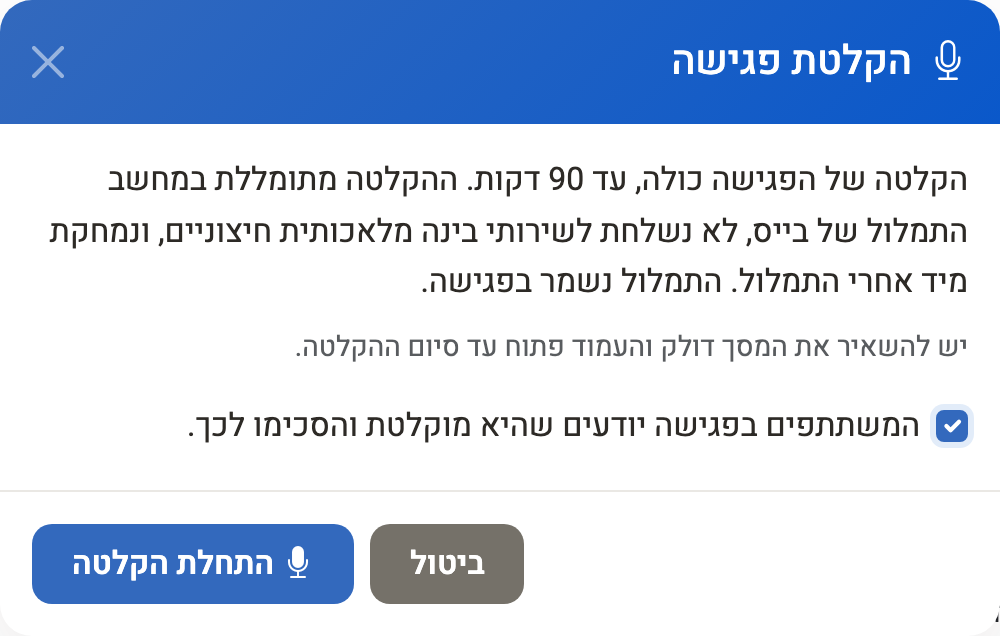
-
Record up to 90 minutes
On the appointment, choose “Record the meeting + transcript”, from the phone or the computer. The recording uploads in parts during the meeting.
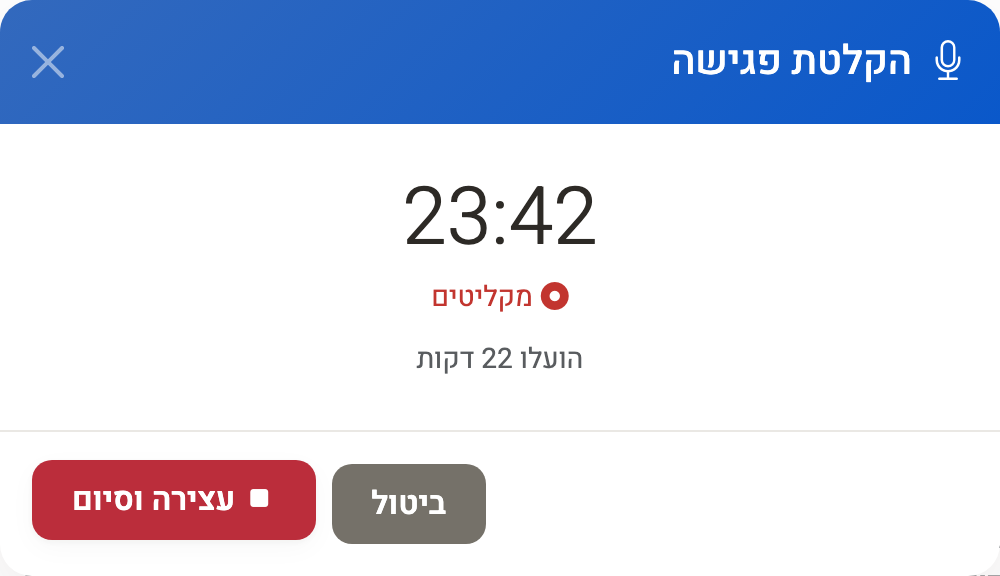
-
The transcript arrives on the appointment
Usually within a few minutes of the end, with a notification. Copy it or add it to the appointment description with one click.
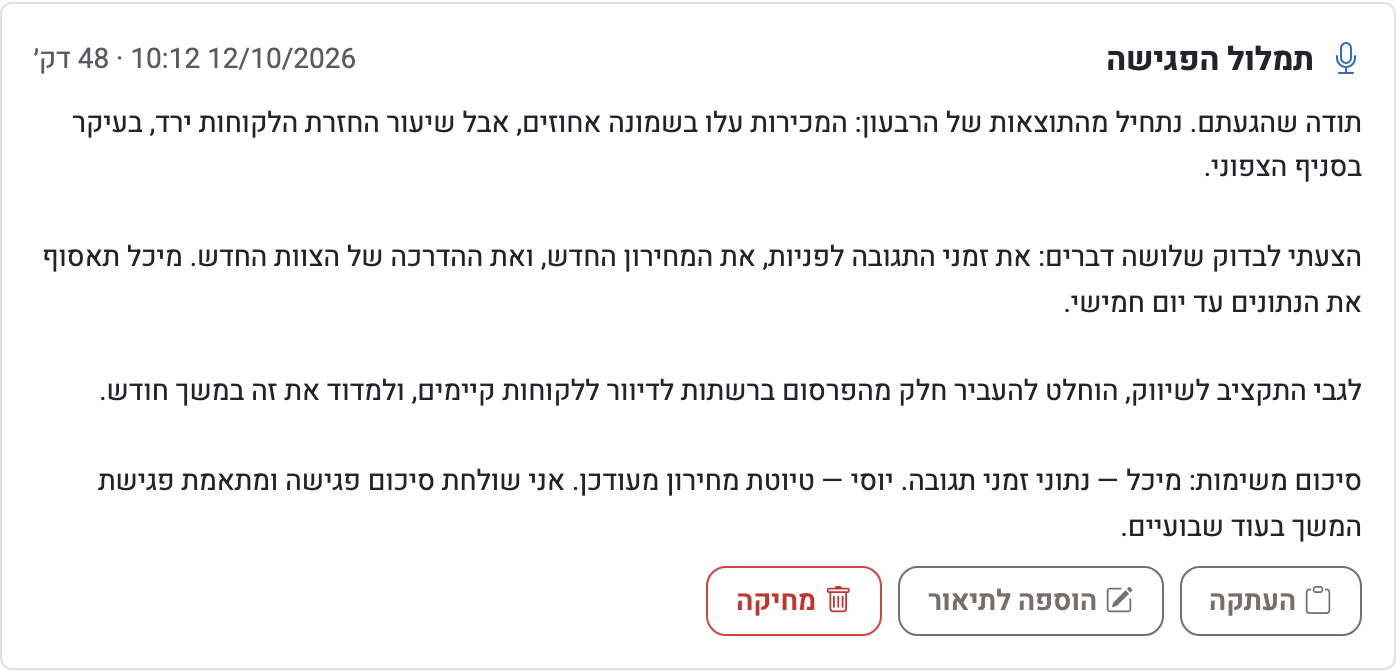


- The recording is transcribed on BaseCRM’s transcription server. It is not sent to external AI services.
- The audio is deleted right after transcription. The transcript is stored encrypted, and everyone authorised to see the appointment can read it.
- The transcription engine was trained on spoken Hebrew.
The transcript usually appears within a few minutes after the recording ends, and a notification is sent when it is ready. If the transcription server is offline at that time, the recording waits for it; a recording not transcribed within 7 days is deleted.
Stop requesting allocation numbers by hand
First year free — For businesses joining by 31.10.2026. When the free period ends: ₪29 a month, locked for the life of the subscription (instead of ₪99), for the whole business. Sign up without a credit card.
Sign up