
Work schedule — who works, when, where and with what, on one board
Instead of a WhatsApp group and a spreadsheet: a daily and weekly board, people and vehicles assigned, a clear mark on whatever is still missing, and a personal link each employee opens on their phone without signing up.
Why scheduling in WhatsApp breaks down
Most small businesses build the week in a WhatsApp group and a spreadsheet, and it works — until somebody swaps a shift in a private message, until the file is sent again and nobody is sure which version is current, and until you discover at eight in the morning that there is no driver. The problem is not that the manager cannot plan; the problem is that three different sources describe the same day.
The work schedule in BaseCRM is one place that says what is happening: what is on the board is what the team sees on their phones, and whatever is missing stays marked as missing until it is filled.
Every job answers five questions
You do not have to fill them all in. A business that schedules only people and hours never sees the rest.
What
Evening shift, delivery to the Cohen family, office cleaning, an installation at a customer. You choose what to call it, and that word appears on every screen.
When
A start and end time, or no time at all. A shift that starts at 22:00 and ends at 06:00 stays on that day's roster — it does not jump to the next day.
Where
An address, a branch or a work site. It shows for the employee too, on their personal link, so they do not have to ask.
Who
As many people as you need, and each slot can name a role — shift manager, bartender, driver, mover. A slot left unfilled stays marked on the board as missing.
With what
A vehicle, a piece of equipment, a room or a machine — assigned exactly like a person, including travel or setup time between jobs. A business that does not need this never sees it.
The things that fall through the cracks
A good schedule is not one that looks nice; it is one that tells you what you forgot.
Unfilled slots
A shift that needs a bartender and has none is marked amber on the board, and the page heading counts how many there are. Clicking the mark opens the list of who is free.
Overlaps
If a person or a vehicle is already taken at that hour, the system says so and shows which job. It does not block you — sometimes the overlap is deliberate, and it is your call.
Who is actually free
When you pick somebody the list is ordered by who is free, and next to each name it says what they are already on, or when they said they cannot work. Nothing to remember.
Auto-filling the gaps
When slots are left empty, the system suggests who fills each one — and you approve.

Distributes it fairly
Whoever is carrying the fewest shifts in the range is picked first. Convenience — already working that day, marked the day as suitable — only ever breaks a tie, never earns anybody an extra shift.

No clashes, and no ignoring what people told you
The proposal never books somebody already taken at that hour, never gives one person two seats on the same job, and never touches anybody who said they are unavailable that day.

Respects your operating hours
Work that falls outside the days and hours you set stays empty, and it says why. One click clears the option and staffs it anyway — your call, not the system’s.

A proposal, not a change
Nothing is saved until you confirm. Every row says why that name was chosen, any name can be swapped or unticked, and whatever could not be filled stays marked as missing instead of disappearing.
How it works
Switch it on
From settings, in two questions: what you schedule and what you call it. Changeable later.

Enter the team
A name and a phone, and that is it. No invitations and no passwords.

Build the week
A template for each regular shift, and duplication of a day or a whole week. The second week takes minutes.

Publish
Until you publish, the schedule is a draft only you can see. After that each employee sees their own on the personal link.

Employees need no account
This is where most scheduling systems get stuck: they require every employee to sign up, install an app and remember a password. In a business with high turnover that simply does not happen, and the roster goes back to WhatsApp.
Here every employee has a permanent personal link. You send it once on WhatsApp and it stays valid. They see only their own shifts, who they are working with and where — and can mark in advance the days they cannot work.
- No sign-up, no password, no app
- No per-employee fee
- You can switch off a leaver's link — and bring it back at the same address if they return
- If a link leaks, that person gets a new one and the old one stops working
What the employee sees
| Today | 16:00–23:00 · Evening shift |
|---|---|
| Tuesday | 11:00–17:00 · Afternoon shift |
| Thursday | Marked unavailable |
One board, completely different businesses
Some businesses repeat the same week; for others every day looks different. Both work here.
Restaurants and cafés
Morning, afternoon and evening shifts that repeat every week. A template for each, week duplication, and an evening shift that ends after midnight stays on its own day.
Security companies
Fixed posts, night shifts, and the same guard who must not appear in two places at once. The by-person view shows each one's week in a single row.
Deliveries and couriers
Every day looks different: a driver, two movers and a truck per delivery. The vehicle gets travel time between jobs, and will not be booked for two deliveries that do not fit.
Cleaning companies
Teams that move between sites. Every job carries its own address, and the employee sees it on their phone before setting off.
Bakeries and production
Night shifts and ovens that cannot run twice at once. An oven is a resource exactly like a person, with a capacity of its own.
Technicians and installations
A visit to a customer, with the customer linked from the system. From the customer's card you see their jobs, and from the job you get back to them.
What the work schedule does not do
Better to know up front than to find out after signing up.
- Time clock and payroll — The schedule plans who works and when. It does not clock people in and out and does not calculate pay. Anyone who needs that keeps the tool they already have.
- Labour-law checking — The system does not check weekly rest, overtime or breaks. That responsibility stays with you.
- Shift swapping between employees — An employee can say in advance that they are unavailable, but cannot swap a shift with a colleague from inside the system. The change is made by the manager.
Frequently asked questions about the work schedule
A team meeting recorded and transcribed — whoever missed it can read it
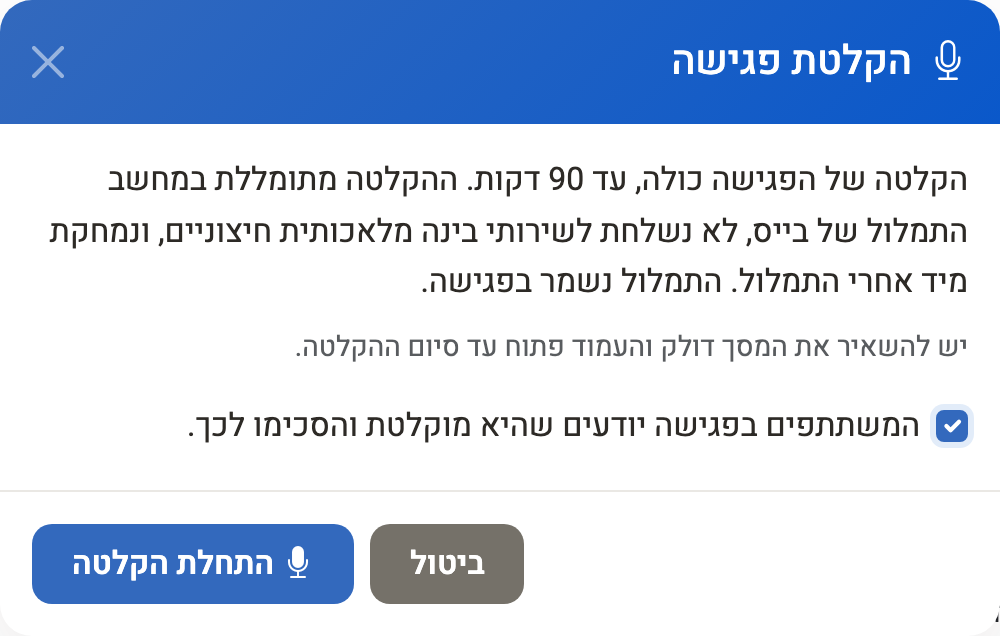
Record a full meeting, up to 90 minutes, and get a transcript attached to the appointment in the calendar — what was decided and who is responsible for what.
- A weekly team meeting
- A briefing before an event or shift
- A feedback conversation with an employee
-
Consent before anything else
Before recording, the participants confirm the meeting is being recorded. Without that confirmation, recording does not start.
-
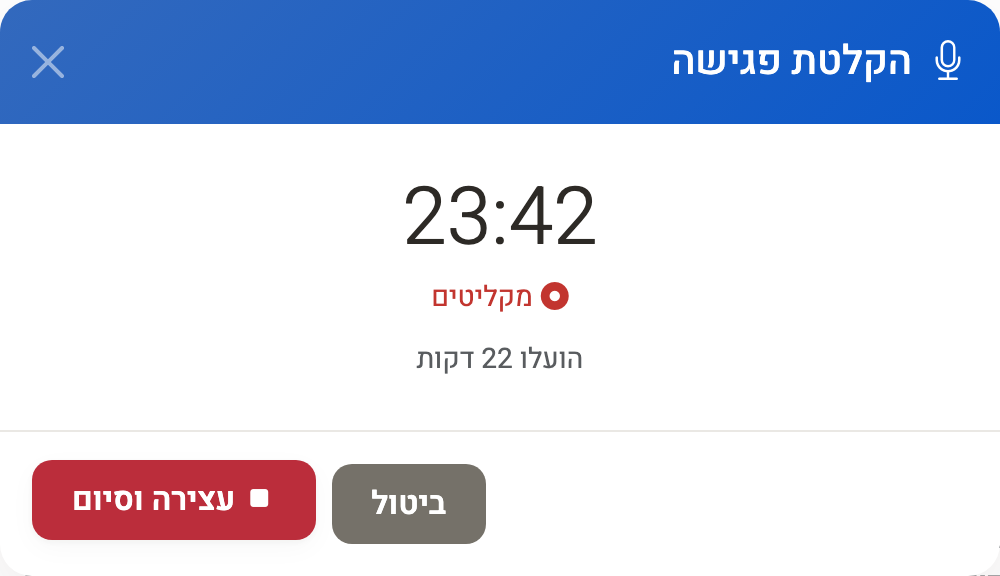
Record up to 90 minutes
On the appointment, choose “Record the meeting + transcript”, from the phone or the computer. The recording uploads in parts during the meeting.
-
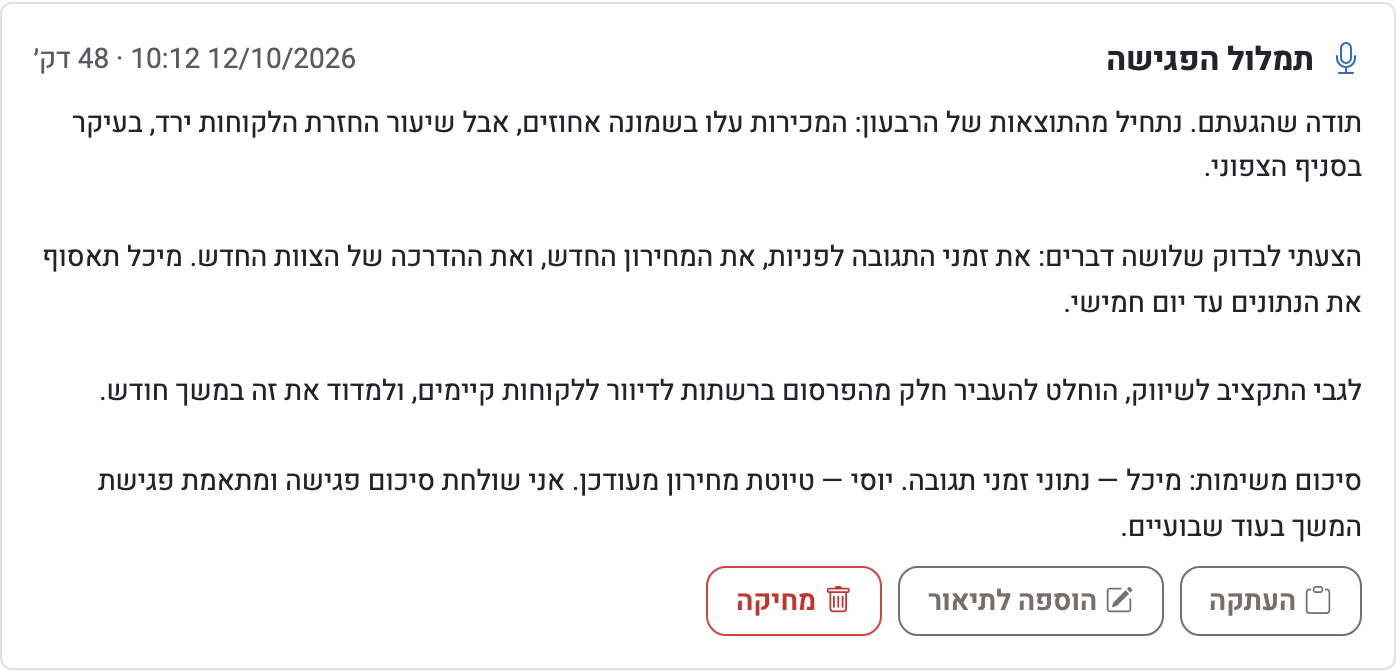
The transcript arrives on the appointment
Usually within a few minutes of the end, with a notification. Copy it or add it to the appointment description with one click.


- The recording is transcribed on BaseCRM’s transcription server. It is not sent to external AI services.
- The audio is deleted right after transcription. The transcript is stored encrypted, and everyone authorised to see the appointment can read it.
- The transcription engine was trained on spoken Hebrew.
The transcript usually appears within a few minutes after the recording ends, and a notification is sent when it is ready. If the transcription server is offline at that time, the recording waits for it; a recording not transcribed within 7 days is deleted.
Stop building the week in WhatsApp
First year free — For businesses joining by 31.10.2026. When the free period ends: ₪29 a month, locked for the life of the subscription (instead of ₪99), for the whole business. Sign up without a credit card.
Sign up