
Law firm software — matters, trust funds and deadlines in one place
Every matter holds everything attached to it: the parties, the deadlines, the hours, the documents and the money. And a client's funds sit in a separate ledger — never mixed into firm income.
The problems that come up in running a law firm
The things general-purpose software does not know how to do
Client funds mixed with income
Court fees and expert fees pass through the firm and get recorded as if they were income — distorting the reports
Deadlines during a recess
Working out a deadline across the summer or Sukkot recess is done in your head or in an outside calculator
Hours never billed
Work that was done and not recorded, or recorded and never reached an invoice
Conflicts of interest
Checking who the firm has acted for — and who it has acted against — without searching your memory
How BaseCRM solves it
The lawyers module is built on top of everything every business in the system already gets — clients, invoices, calendar and documents
A trust-fund ledger — kept apart from firm income
Money received from a client for a court fee, an expert fee or any payment passing through the firm is recorded in a separate trust ledger, with a balance per client and per matter.
- The funds do not enter the VAT report, turnover, the Uniform Format filing or the matter's profit
- A trust-receipt acknowledgement in its own numbering series — an internal document, not a tax document
- A ledger entry is never deleted and never edited: a correction is posted as an opposing reversal entry
- You cannot withdraw more than the balance the firm holds for that client

One matter with everything attached to it
Each matter records the court level, the court, the case number, the bench, the side we represent, the stage of the proceeding and the limitation date — alongside the parties, documents, tasks and meetings.
- Legal matter stages: preliminary review, pleadings, hearings, awaiting judgment, appeal
- Parties and participants by role: client, opposing party, opposing counsel, expert, witness
- Files, digitally signed agreements, tasks and calendar — all on the same matter
- The Net HaMishpat case number is stored as a reference field. There is no interface to, or synchronisation with, the Net HaMishpat system.

A procedural deadline calculator with court recesses
Calculates the final date from service or from the decision, with the days of the Sukkot, Pesach and summer recesses excluded — and the system shows how it got there, not only the result.
- Choose the basis of the period: set by the regulations, set by the court, or fixed by statute
- A period fixed by statute — such as limitation — runs continuously and is not extended by a recess, as it should be
- The upcoming recesses and their exact dates, shown on the page
- An aid to your own check — not a substitute for it. Covers civil procedure.

Conflict-of-interest checking
Before accepting a representation — search by name, ID number or phone across the firm's clients, the parties in every matter, and the professional contact book.
- Also finds people who are not clients: the opposing party in an old matter, an expert the firm once retained
- Matches even when the name is spelled differently — quote marks, Ltd., a title or vowel points
- Every match is marked with its strength, so the distant ones can be dismissed at once
- A source that could not be searched is shown as such — and never counted as "clear"

Time tracking and hourly billing
A timer or manual entry, per matter and per client, with an hourly rate set at client, matter or lawyer level — and an invoice raised from the hours not yet billed.
- Hours are marked as billed once invoiced, so they cannot be billed twice
- A rate for each lawyer in the firm — and a rate agreed with the client overrides it
- Costs the firm fronted — court fees, expert fees, service — attached to the invoice for reimbursement
- An hours report for the client, to export or attach to an invoice
- A fee model per matter: hourly, fixed sum, retainer or a percentage of the outcome

For the solo lawyer, and for the firm
The same system — without a sole practitioner having to work around fields that mean nothing to them
Solo
Fields such as "handling lawyer" or "deadline owner" are simply not shown — there is only one possible answer, and the system fills it in itself.
Firm
The moment another lawyer joins, those same fields appear on their own — matter assignment, deadline owner, and an hourly rate per lawyer. Everything recorded earlier stays correct — no conversion and no re-entry.
Frequently asked questions
A consultation with a client — recorded, transcribed and saved on the appointment
Record a full meeting, up to 90 minutes, and get a neat transcript — to go back to the facts, dates and instructions the client gave without relying on memory.
- An introductory, fact-gathering meeting on a new case
- Preparing for testimony or a hearing
- A meeting with several parties, when every detail matters
-
Consent before anything else
Before recording, the participants confirm the meeting is being recorded. Without that confirmation, recording does not start.
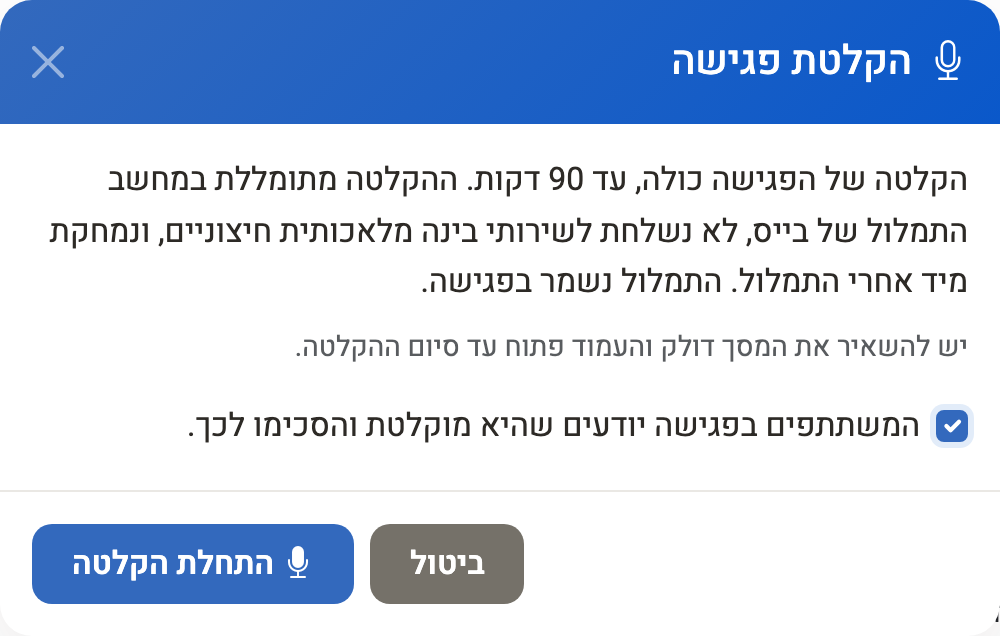
-
Record up to 90 minutes
On the appointment, choose “Record the meeting + transcript”, from the phone or the computer. The recording uploads in parts during the meeting.
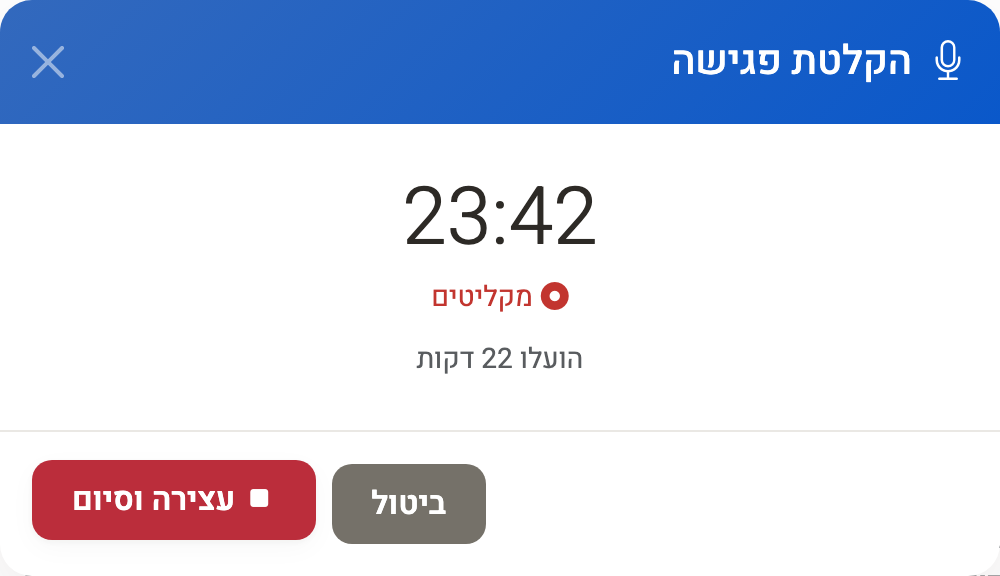
-
The transcript arrives on the appointment
Usually within a few minutes of the end, with a notification. Copy it or add it to the appointment description with one click.



- The recording is transcribed on BaseCRM’s transcription server. It is not sent to external AI services.
- The audio is deleted right after transcription. The transcript is stored encrypted, and everyone authorised to see the appointment can read it.
- The transcription engine was trained on spoken Hebrew.
The transcript usually appears within a few minutes after the recording ends, and a notification is sent when it is ready. If the transcription server is offline at that time, the recording waits for it; a recording not transcribed within 7 days is deleted.